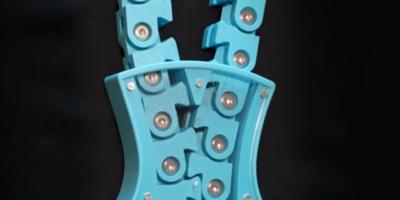
Functional 3D printed zipper developed using FDM and MJF technologies
This project demonstrates how IPFL uses FDM and MJF 3D printing for functional prototyping of mechanical components, supporting rapid development from concept to working systems.
IPFL is a UK 3D printing service specialising in functional prototyping and low-volume production of plastic components.
IPFL supported the development of a large-scale functional zipper mechanism featured in a Veritasium video exploring how zippers work. The project required translating a traditionally small, high-precision mechanism into a scaled, demonstrable system while maintaining real functionality.
The aim was to make the mechanism visible, repeatable, and fully functional.


A zipper is a deceptively complex mechanical system. Its function relies on precise geometry, alignment, and controlled deformation of interlocking elements.
Scaling this up introduced new challenges, including increased friction, reduced tolerance forgiveness, structural instability, and greater sensitivity to material behaviour.
This meant the design required iterative development and careful process selection to achieve reliable performance.
Development Using FDM and MJF 3D Printing
FDM 3D printing and MJF 3D printing were both explored and compared, particularly in relation to surface finish, mechanical behaviour, and overall functionality.
FDM 3D printing was used during development for rapid prototyping and large-scale components. Its ability to produce lightweight, hollow structures made it highly effective for scaling the mechanism, while also enabling colour-ready parts suitable for visual demonstration. These characteristics ultimately made FDM the preferred choice for the final feature video.
MJF 3D printing was also evaluated due to its higher dimensional accuracy and more consistent surface finish. While it produced strong, solid components with reliable mechanical properties, the increased weight and requirement for post-processing made it less suitable for this specific large-scale application.
Rather than a linear progression from FDM to MJF, both processes were assessed in parallel, with final selection driven by performance, weight, and visual requirements.
Functional Testing of 3D Printed Mechanical Components
Multiple iterations were produced to validate engagement consistency, slider force requirements, wear and durability, and tolerance sensitivity across both FDM and MJF 3D printing processes for the Rapid Prototyping requirements.
The final system demonstrated consistent performance and reliable operation under repeated use.
The finished assembly successfully demonstrates the internal mechanics of a zipper while operating as a functional system. It highlights how geometry, material selection, and manufacturing process directly influence performance in mechanical components.
This project reinforced the importance of selecting the right additive manufacturing process when developing functional prototypes, depending on the specific requirements of the application.
Why This Matters
This case study highlights how additive manufacturing can be used for functional prototyping, not just visual models.
Using FDM and MJF 3D printing, IPFL can develop mechanical components quickly, validate performance, and transition into low-volume production where required.
This approach is widely used in rapid prototyping of mechanical components where performance and iteration speed are critical.
Projects like this demonstrate how 3D printing services can support engineering development, educational tools, and working mechanical systems.

Large-scale functional zipper developed for Veritasium
Iterative development using FDM and MJF 3D printing
Process comparison based on surface finish, weight, and functionality
FDM selected for final application due to lightweight structure and visual suitability
Final system demonstrates reliable mechanical behaviour
At IPFL, we specialise in functional 3D printed components, using technologies such as FDM and MJF 3D printing for rapid prototyping and low-volume production of plastic components across a range of industries.
Projects like this highlight how additive manufacturing can be used to develop reliable mechanical systems quickly and effectively.